In modern policing, CCTV is often central to investigation and prosecution. From high street incidents to serious organised crime, the ability to lawfully retrieve, manage and present CCTV footage can directly determine whether a case succeeds in court.
CCTV evidence is often scrutinised and may be challenged in court, for example, if the chain of evidence is incomplete, validity and authenticity could be questioned, security of evidence could be challenged, or evidence is exhibited incorrectly.
This is why CCTV footage must be handled with the same care as physical evidence. A thorough understanding of how evidence is obtained, recorded, secured, and presented is essential to ensure its integrity and admissibility during an investigation. This means that those in the police force and other professionals, such as CCTV operators, need a fundamental understanding of investigation skills along with the competence to correctly handle and use CCTV footage.
What are the core competencies involved in CCTV investigation skills?
Roles, responsibilities and legislation
Users need to understand:
- Legal frameworks including PACE, RIPA and the Data Protection Act
- Continuity of evidence
- Management of Police Information (MoPI)
- Criminal vs civil proceedings
- How and why CCTV evidence is challenged.
This makes sure that users understand not only how CCTV can be used as part of an investigation, but how it becomes legally defensible and admissible in prosecutions.
CCTV systems and health and safety
Technical capabilities with different types of CCTV systems and understanding how and where to access them are paramount to using CCTV as a part of an investigation. For example, CCTV systems can often be in industrial or remote locations, and technology capability varies across the systems that have been installed over the years. That means investigators need an understanding of:
- DVR and NVR systems
- Recording resolutions (720p, 1080p, 4K, 8K)
- Storage formats and FPS considerations
- Camera masking and privacy implications
- Working safely in unknown premises.
Who needs these skills?
- Those working within police forces
- Those working on behalf of police forces
- Those responsible for CCTV evidence retrieval
- Those handling digital evidence in investigations.
For example, operational roles who might retrieve and handle CCTV can include police constables, detective constables, CID officers, volume crime investigators, digital media investigators, neighbourhood policing teams, response officers, scene of crime officer.
Non-operational roles might include police staff investigators, contractors, digital support staff, and accredited private sector investigators. In addition, some of these skills could benefit business owners, employees and security staff.
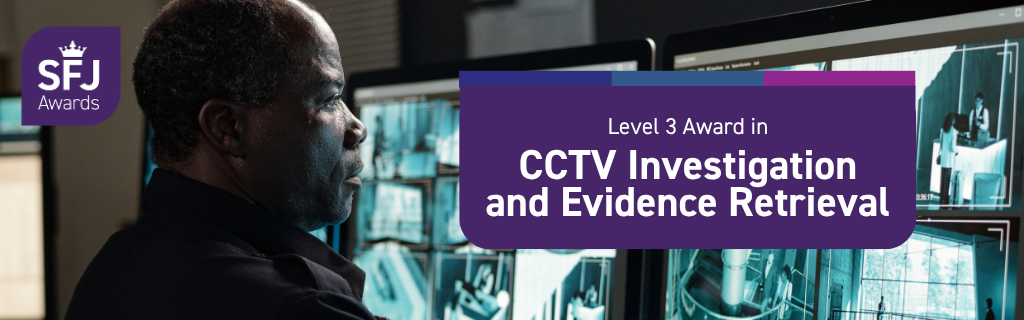
Level 3 Award in CCTV Investigation and Evidence Retrieval
The SFJ Awards qualification provides formal recognition that learners have the skills and knowledge needed to use CCTV footage as part of an investigation. It doesn’t only cover the theory alone – it covers everything above as well as a practical assessment unit which tests and assesses the learner’s capabilities.
The observed practical assessment covers:
- Navigating CCTV systems
- Conducting CCTV system searches
- Downloading CCTV footage e.g. exporting in native format or on WORM where appropriate
- Installing and testing DVR/NVR units.
It also reinforces good practice in seizure procedures, maintaining continuity and audit trails, and ensuring evidence is court-ready – including compatibility checks, exhibit management and working copies.
This bridges the gap between theory and frontline application, going much further than simply understanding how to download footage.
Why training providers should act now
CCTV evidence is ever-increasing. With greater camera coverage, higher resolution and more reliable systems and storage methods, alongside increased legal scrutiny, police forces and those who work with them require consistent and defensible training standards in this area.
Delivering this qualification can:

Strengthen learning and development programmes

Offer operationally relevant CPD

Support evidential integrity across investigations
Apply for approval to deliver this qualification
Learn more about this qualificationIf you’re looking to strengthen your regulated training provision and support operational capability in the sector, get in touch with us to get started today.
"*" indicates required fields