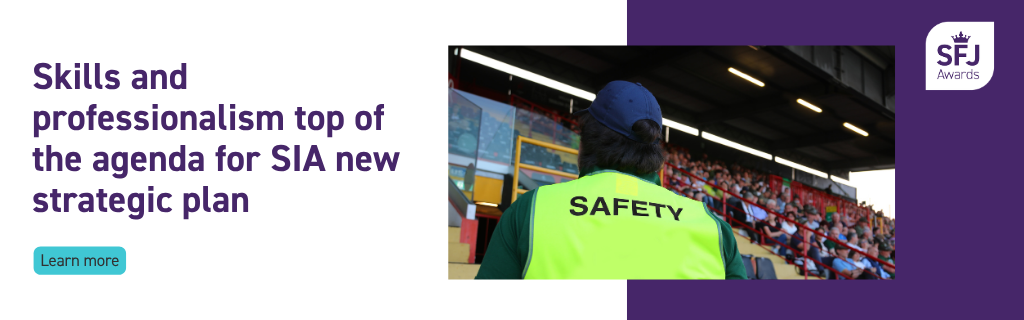
The publication of the Security Industry Authority’s new Strategic Plan 2026–2029 marks an important moment for everyone involved in protecting people, places and communities across the UK.
For more than twenty years, the Security Industry Authority (SIA) has played a central role in professionalising the private security industry through the regulation of individuals and the setting of minimum standards. Its new strategy signals the next stage of that journey. It is an ambitious vision that places greater emphasis on quality, professionalism and public confidence, while recognising the increasingly important role that protective security plays in modern society.
Perhaps the most significant change is the expansion of the SIA’s remit through Martyn’s Law. By becoming the regulator not only of people and businesses, but also of the preparedness of publicly accessible premises and events, the SIA is helping to embed a culture where security is considered a fundamental part of good management and public service rather than an afterthought.
A changing risk landscape demands higher standards
This evolution could not come at a more important time. The nature of the risks facing the UK continues to change. Terrorism remains a real threat, while security professionals are increasingly called upon to respond to issues such as violence against women and girls, safeguarding vulnerable individuals, crime and the management of major public events. In many situations, security personnel are the first people to recognise a developing incident and the first to act before the emergency services arrive.
Against that backdrop, the SIA’s commitment to move beyond simple compliance and place a greater focus on the quality of security provision is both welcome and necessary. Public safety depends not just on having licensed individuals in place, but on ensuring that they possess the right knowledge, skills and behaviours to make sound decisions in complex and often fast-moving situations.
The same principle applies to organisations. Effective protective security is not delivered by a single policy document or training course. It is created through a combination of leadership, planning, competent people and a culture of continuous improvement. The introduction of Martyn’s Law is already encouraging organisations across the UK to think differently about preparedness and resilience, helping to ensure that proportionate and practical measures become part of everyday operations.
Building public trust through professionalism
Crucially, this is not simply about regulation. It is about building public trust and confidence. When people attend a concert, visit a shopping centre, go to a football match or enjoy a night out, they should be able to do so with confidence that those responsible for their safety have the competence and preparation needed to respond effectively should the worst happen. Likewise, employers and buyers of security services need assurance that the standards they see on paper are reflected in the quality of delivery on the ground.
Raising the bar through skills and qualifications
That is why the SIA’s focus on strengthening qualifications, tackling training malpractice and raising standards across the security ecosystem is so important. High-quality, regulated qualifications have a critical role to play in supporting professional practice and creating clear pathways for development and progression. They help establish a common standard of competence while giving employers confidence that their workforce has been trained and assessed rigorously.
As the security profession continues to evolve, the need for specialist knowledge in areas such as protective security, resilience, counter-terrorism awareness and risk management will only grow. Developing those capabilities across the workforce is a shared responsibility. Regulators, employers, awarding organisations, training providers and government all have a part to play in creating a system that encourages excellence and supports continuous professional development.
Supporting the sector to meet the challenge
At SFJ Awards, we see first-hand the difference that high-quality qualifications and assessment can make. Already working with employers, public bodies, sector experts, and training providers, our aim is not simply to certify learning, but to help build a workforce that is competent, confident and equipped to protect the public. We believe that qualifications and training should evolve alongside the risks and challenges faced by industry, ensuring that standards remain relevant and meaningful.
The SIA’s new strategy provides a strong framework for achieving that ambition. By supporting higher standards, encouraging innovation and promoting collaboration across the protective security community, it creates an opportunity for the sector to further strengthen its professionalism and reinforce public confidence.
Looking ahead
The challenges ahead are significant, but so too is the opportunity. If we can continue to work together (regulators, employers, educators and practitioners alike) we can build a security profession that is recognised not only for its vital operational role, but for its contribution to safer communities, more resilient organisations and better protected public spaces.
Ultimately, investing in skills and professionalism is not simply an investment in the security industry. It is an investment in public safety itself.